A spec sheet gives you numbers. Frame load rating, motor count, recline angle, seat width, caster diameter. All useful, all measurable, and all sitting right there in a neat column for you to compare across suppliers. The problem is that the numbers rarely tell you how a chair behaves once a patient sits in it for the fourth hour of an infusion. That gap between what gets printed and what gets experienced is where most buying mistakes with medical recliner chairs happen.
If you run the task of procurement for a clinic or an infusion suite, you have probably compared medical recliner chairs on paper more than once. Two chairs can look almost identical in a side-by-side table. Same frame material, similar weight capacity, comparable price. Then one of them ends up loved by the nursing team and the other ends up pushed into a corner. Here is why that happens, and what the document in your hands leaves out.
Comfort Over Long Treatment Sessions
A cushion depth of 4 inches means nothing on its own. What matters is how the foam holds up after two years of daily use, and how pressure spreads across the seat when someone stays put for a long session. Cheap padding compresses and flattens. The patient starts shifting, asking to be repositioned, or quietly enduring the discomfort while their treatment continues.
Esthetica Medical Furniture builds its medical recliner with a seat cushion shaped for extended use, which is the kind of detail you only appreciate later. You cannot read foam density fatigue on a spec sheet. You learn it from talking to facilities that have run the same chair for a few years, or from sitting in one yourself for twenty minutes and noticing whether your lower back starts complaining.
See also: How Mattress Toppers Help Extend the Life of Your Existing Mattress
Patient Access and Nurse Workflow
Swing-away side arms show up as a single line item. What that line does not capture is how much easier a phlebotomist’s day gets when a patient can enter and exit without a fight. A nurse moves between chairs dozens of times a shift. Small friction in access adds up into real fatigue and slower turnover.
Think about the last time you watched an elderly patient try to climb into a fixed armchair. Now picture the arm swinging clear so they can settle sideways and pivot in. The Esthetica Medical Furniture recliner uses swing-away arms for exactly this reason. The spec sheet says the feature exists. It does not say your team will stop dreading the difficult transfers.
Mobility Inside a Busy Unit
Every recliner lists caster wheels. Ours run on 3-inch casters. But wheel diameter alone does not tell you whether a loaded chair rolls smoothly across a slightly uneven floor, or whether it catches and needs a shove. Movement matters more than buyers expect, because clinics rearrange constantly. Cleaning crews need to reach the wall. A chair might move to a window for a patient who wants light.
A recliner that repositions easily saves your staff from lifting and straining. One that resists turns a simple task into a two-person job. You will not find this distinction printed anywhere, and the honest answer is you often have to test it on your own floor.
Little Additions That Change the Day
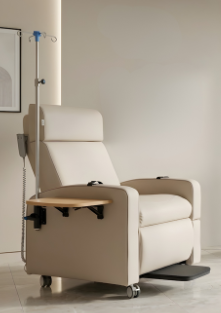
Some features look minor on paper and turn out to matter a lot in practice. The Esthetica Medical Furniture recliner includes several of these:
- Two fold-down side tables, one on each side, for personal items or supplies
- A built-in food tray for patients during longer visits
- A retractable footrest that tucks away when not needed
- An IV pole stand attached to the chair itself.
- A handheld remote so positioning does not require calling for help
Read that as a list and it looks like a features dump. Watch it in use, and you see a patient who can keep a drink, a phone, and a snack within reach without a nurse fetching a separate table. That is the difference between a chair that supports care and one that seats a body.
Frame Strength You Cannot See
A reinforced powder-coated steel frame appears on the sheet as a phrase. In daily terms, it means a chair that does not wobble after eighteen months, does not develop a creak, and does not need early replacement. The finish resists the constant wiping and disinfecting that clinical settings demand.
Frame quality is perhaps the hardest thing to judge before purchase, because everything looks solid in a showroom or a photo. You are really betting on the manufacturer. A company that cuts, welds, and finishes its own frames has more control over that outcome than one assembling parts from elsewhere. Esthetica Medical Furniture manufactures in-house at its Manesar facility, and that matters when a frame has to last.
In Closing
Numbers help you shortlist the equipment that you need. They do not tell you how a chair feels at hour four, how your nurses will treat it, or whether it will still be steady in three years. Those answers come from testing, asking, and choosing a manufacturer that stands behind what it builds.